 EA4FSI
Summary
This article describes the use of radiograms as a standardized way of transmitting messages reliably through Amateur Radio and REMER networks, particularly during emergency operations.
1. Introduction
The purpose of radiograms is to provide reliable transmission of a message between any origin and destination through an Amateur Radio network or REMER, using voice, digital communications, or a combination of both.
In emergency communications, it is essential that information sent from an origin reaches its destination unaltered. This can be difficult when retransmission through several stations is required and because of the stress inherent in emergency operations.
Radiograms provide a common, recognized format for transmitted information, making it easier to relay the message until it reaches its destination.
This method has been used successfully by ARRL since 1915 and is now known as the National Traffic System (NTS).
Its use is also consistent with the IARU HF Operating Procedure for International Emergencies, approved by all three IARU Regions.
2. The relay chain
During an emergency, a person or organization, such as a victim or a Civil Protection service, may need to send a message to a recipient who cannot be reached directly through the available telecommunications systems, either because they have no coverage in the area, are overloaded, or have become unavailable.
The Amateur Radio Service or REMER can act as a relay mechanism for these messages until they reach their recipients.
The relay chain therefore begins with the originator of a message, who may or may not be an amateur radio operator. When the message reaches the first amateur radio operator, the first radiogram is prepared and relayed by radio between the stations in the network until it reaches a station that can contact the recipient directly and make the final delivery.
3. Radiogram format
The radiogram designed for REMER is based on the format used by ARRL.
The proposed radiogram contains the following fields:
- Number: sequential number assigned by the first radio station in the chain.
- Precedence: indicates the priority of the message. Three levels are defined:
- Urgent: highest level, for situations in which people's lives are at stake.
- Service: routine service traffic during an operation.
- Routine: traffic under normal circumstances.
- Station of origin: call sign of the first amateur radio station in the chain to receive the message from the originator.
- Place of origin: location of the person who originated the message.
- Time and date filed: time and date when the first amateur radio operator in the chain received the message from the originator and copied it onto the radiogram.
- Originator: person or organization that originated the message.
- Recipient: person or organization to whom the message must ultimately be delivered.
- Message: body of the message. For easier reading, each word should be written in uppercase within the designated space.
The contents of all the fields described above remain unchanged throughout successive relays.
In the «Radiogram received by» section, each station that has participated in the relay chain enters its own details. This information is not relayed to the rest of the chain.
Download the radiogram designed for REMERPDF · Radiograma_REMER.pdf Download the ARRL radiogramPDF · radiogram2.pdf4. Operating procedure
The operating procedure is illustrated by the following practical example.
The mayor of the town of El Molar, affected by an emergency, needs 100 blankets for an evacuation shelter. He wants to request these blankets from the Government Delegation in Madrid, but telephone communications are unavailable, so he must rely on amateur radio operators deployed in the area.
The chain established to deliver the message is shown in Figure 1.
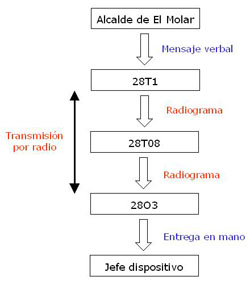
The mayor contacts amateur radio operator 28T1 by voice, explains his needs, and provides the message to be transmitted. Operator 28T1 copies it onto a radiogram.
Immediately afterwards, 28T1 contacts 28T08 by radio, the next operator in the chain leading to the Government Delegation:
28T1: 28T08 from 28T1.
28T08: Go ahead, 28T1.
28T1: I need to transmit a radiogram. Please let me know when you are ready.
28T08: 28T08 ready to copy.
28T1: Message number 004 begins.
Precedence: service.
Station of origin: 28T1.
Place of origin: El Molar.
Time filed: 2 September at 22:30 EA.
Originator: Mayor of El Molar.
Recipient: Government Delegate in Madrid.
Message: one hundred blankets are required for the municipal shelter.
End of message 004. Please confirm receipt.28T08: 28T08 has received and copied message 004.
At this point, 28T08 copies the data onto its own radiogram.
The procedure is then repeated between 28T08 and 28O3, which in turn copies the message onto its own radiogram and may deliver it in person or by telephone to the head of the team working with the Government Delegate.
The delivered radiogram is shown in Figure 2.
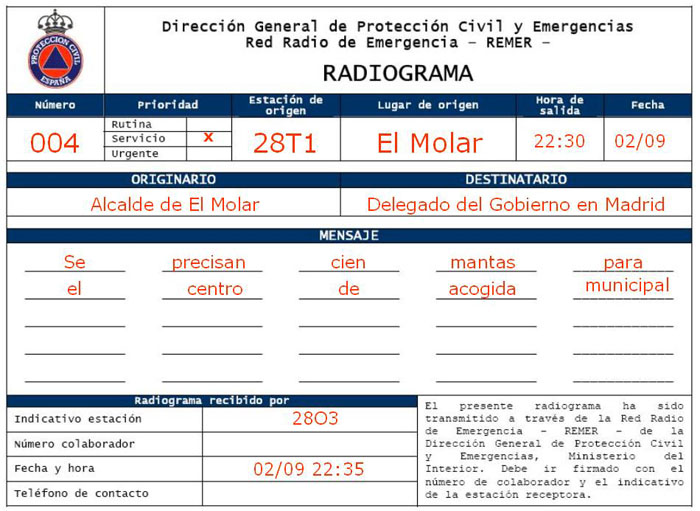
At this point, it is important to confirm receipt of the message in the reverse direction of the chain. 28O3 would contact 28T08 and inform the station that «message 004 has been delivered to the recipient», and so on until the originator is reached.
All stations that are to form part of a chain must therefore have printed radiograms ready to be completed.
Radiograms also make it possible to organize radio exercises and drills very easily, without the need to deploy field personnel.
5. Digital communications
When digital communications are used to relay radiograms, it is advisable to use a compact radiogram format so as not to consume excessive bandwidth or slow down transmissions.
The following plain-text format can be used:
---------------------------------------------------------------------------------
REMER DGPCE RADIOGRAM

Number:
Precedence: R/S/U (delete as appropriate)

Station of origin:
Date filed:
Time filed:

Place of origin:
Originator:

Recipient:

Message:


END OF MESSAGE
---------------------------------------------------------------------------------