 EA4FSI
Summary
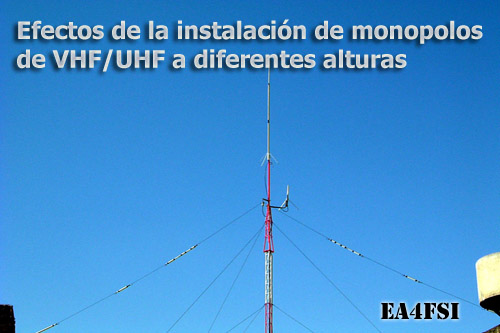
The height above ground at which a monopole antenna is installed may affect its radiation efficiency, since part of the energy radiated by the antenna is reflected by the ground and returns to the antenna. Depending on the height "h" at which the antenna is located above ground, the reflected wave will interfere constructively or destructively with the radiated wave, causing the radiation resistance, and therefore the gain, to vary with height "h". Antenna height also affects other radio-link parameters, such as possible intersections between obstacles and the first Fresnel-zone ellipsoid. This analysis considers only parameters inherent to the antenna itself.
Originally published on 21/12/2009.
| VHF | 146 MHz · L = 2.05 m |
|---|---|
| UHF | 435 MHz · L = 0.7 m |
| Antenna | ¼-wavelength monopole with 4 radials |
| Heights analysed | 0 < h ≤ 12 m |
| Ground | Infinite medium ground |
1. Antenna model used for the analysis

For the VHF analysis, the antenna consists of a quarter-wavelength monopole and four radials of the same length, spaced 90° apart and inclined 45° with respect to the monopole. It is designed for a centre frequency of 146 MHz (L = 2.05 m) and located at a variable height "h" above ground. The analysis considers installation heights up to 12 metres (0 < h ≤ 12 m) and an infinite medium ground.
For the UHF analysis, the conditions are identical, but the antenna is designed for a centre frequency of 435 MHz (L = 0.7 m).
2. Effects on the standing wave ratio (SWR)
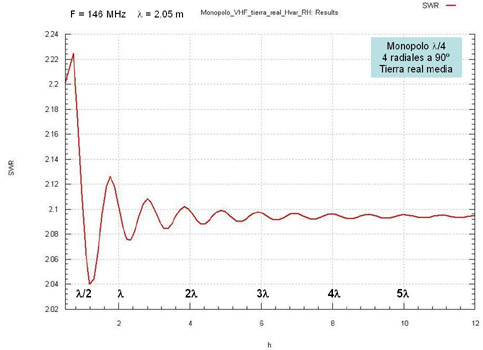
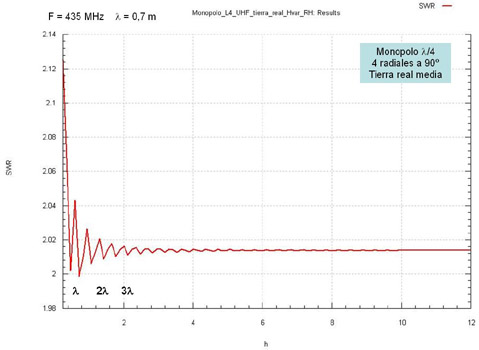
In both cases, the effects on the standing wave ratio are extremely small and are only noticeable when the antenna is installed at a low height.
3. Effects on antenna gain
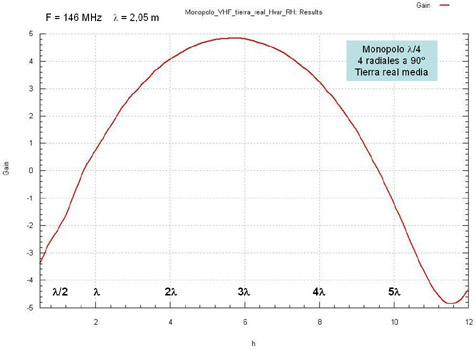
It can be observed (Fig.4) that the optimum height above ground for a monopole in the 2 m band is around 6 metres (3 × the wavelength). If the monopole is installed at 12 metres (6 × wavelength), the antenna will have 9 dB less gain than at the previous height. All gains have been calculated at a 5-degree take-off angle. The gain curve is periodic.
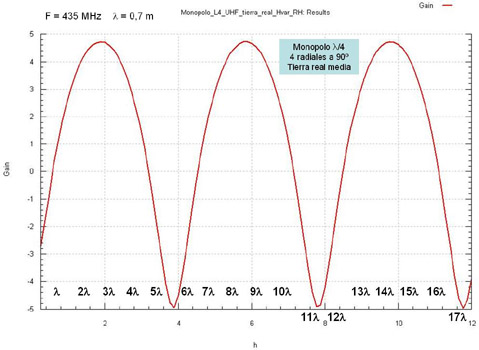
For the 70 cm band (Fig.5), for masts up to 12 metres, there are several heights of interest: 2 m, 6 m and 10 m, corresponding to 3, 9 and 15 times the operating wavelength. There are other heights that should be avoided: 4 m, 8 m and 12 m, corresponding to 6, 12 and 18 times the operating wavelength. All gains have been calculated at a 5-degree take-off angle. The gain curve is periodic.
4. Conclusions
For a given installation height "h" of a ¼-wavelength monopole above ground in the VHF and UHF bands, operating at a wavelength λ, the following can be stated:
h = 3n × λ → maximum gain
h = 6n × λ → minimum gain
where "n" is an integer.
Video 1. Evolution of the vertical radiation pattern vs. height above ground (h), in metres, for the VHF antenna
Video 2. Evolution of the 3D radiation pattern vs. height above ground (h), in metres, for the VHF antenna