 EA4FSI
Warning: This simulation model is provisional and remains under development. The results may be inaccurate or contain errors.
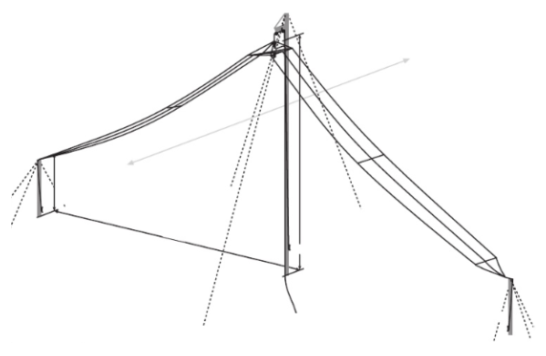
| Type | Broadband multiwire dipole (inverted-V configuration) |
|---|---|
| Manufacturer | Codan Limited (Australia) |
| Impedance | 50 Ω |
| Simulation | MMANA-GAL |
| Band | 2–30 MHz |

1. Antenna design and simulation.
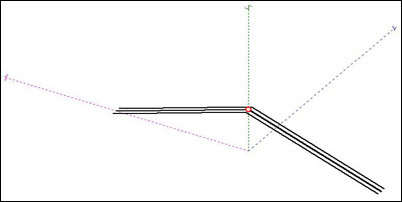
The C463 is a three-wire broadband dipole suitable for automatic link establishment (ALE). It incorporates a balun and loading elements whose electrical characteristics are not publicly specified by the manufacturer. It can be installed horizontally, favouring longer-distance (DX) communication, or in an inverted-V configuration, favouring near-vertical incidence skywave (NVIS) propagation.
2. Simulated radiation patterns.
This section presents radiation patterns simulated with MMANA-GAL at selected frequencies.

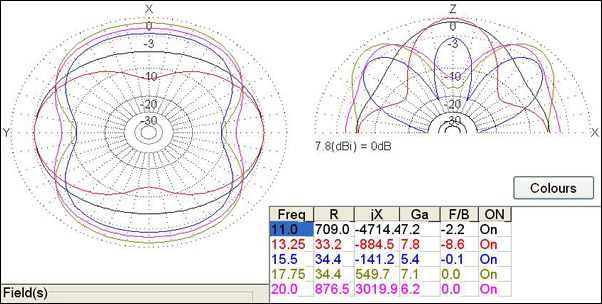
At frequencies up to 10 MHz, the simulated radiation patterns are approximately omnidirectional in azimuth and favour NVIS propagation. The maximum simulated gain in this frequency range is approximately 7.5 dBi. Above 10 MHz, the radiation patterns become more irregular and vary significantly with frequency. For this reason, a horizontal installation may be preferable for longer-distance (DX) communication.